
Thermal effects on vibration and stability of functionally graded cylindrical shells surrounded by Pasternak elastic foundation
Abstract
Vibration and stability analyses of functionally graded cylindrical shells surrounded by elastic foundation under axial and thermal loads are investigated in this paper. Using Hamilton’s principle, governing equations are derived based on first-order shear deformation theory (FSDT) assumptions and Sanders-Koiter formulation. Galerkin’s method is implemented to achieve the relevant expressions for frequency parameters and critical axial/thermal loads. Emphasis is placed on the solution method to derive a more accurate heat conduction equation through the shell thickness. The following two solution methods are considered: analytical exact solution and polynomial series solution. In some cases the latter solution method that has extensive application is observed to have some significant effects on the results, especially on the stability characteristics. A comprehensive validation of the results also has been provided.
Keywords: FG cylindrical shell; Vibration and stability; Axial and thermal loads; Pasternak Elastic Foundation.
- Introduction
The use of functionally graded materials (FGMs) in various applications has increased in recent years. The idea of FGMs was first introduced by a team of Japanese scientists in 1984 [1]. FGMs are a form of composite materials that are designed to have desired properties for specific applications. FGMs are considered as a solution for the aerospace industries where high temperature resistance and lightweight but stiff structures need to be provided. These new materials with excellent thermo-mechanical properties are resistant to high temperatures. Functionally graded (FG) cylindrical shells also have extensive applications in different engineering structures, such as aerospace, pressure vessels and pipes, chemical plants, etc.
Struggling to structure your research paper?
From thesis statement to conclusion, our research paper writers build strong, evidence-driven arguments using peer-reviewed sources. We cover APA, MLA, Harvard, and Chicago — undergraduate through doctoral level, across all disciplines.
✓ Plagiarism-free · ✓ 100% human · ✓ Free revisions · ✓ Confidential
🔒 No payment to start · From 3 hrs
 Among the various researches on FGMs, one of the most interesting issues is to analyze the vibration and stability behaviors of shells. Analytical study of the shells predicts the necessary mechanical measures to avoid the expected damage to the system and ensures its safety and stability. Many studies have been reported on the vibration and stability of FG cylindrical shells (Loy et al. [2], Pradhan et al. [3], Najafizadeh and Isvandzibaei [4, 5], Matsunaga [6], Tornabene [7], Huang et al. [8], Malekzadeh and Heydarpour [9], Ebrahimi and Sepiani [10] and Naeem et al. [11]). Isvandzibaei et al. [12] investigated vibration behavior of FGM cylindrical shells including internal pressure and ring support effects based on Love-Kirchhoff theory with various boundary conditions. Mechanical buckling analysis of moderately thick FG cylindrical panels subjected to axial compression for combinations of clamped and simply supported boundary conditions is considered by Golmakani et al. [13]. Hadi et al. [14] studied free vibration characteristics of FGM cylindrical shells surrounded by elastic medium under axial force, lateral pressure and different boundary conditions using wave propagation method.
Free vibration analysis of simply supported FG cylindrical shells in thermal environment based on Love’s thin shell theory was performed by Haddadpour et al. [15]. Pradyumna et al. [16] investigated free vibration and buckling behavior of singly and doubly curved FG shell panels in thermal environments. Thermal buckling loads of cylindrical shells of functionally graded materials were investigated by Shahsiah and Eslami [17]. Sheng and Wang [18] investigated the effect of thermal load on the vibration, buckling and dynamic stability of FG cylindrical shells embedded in a linear elastic medium, based on the first-order shear deformation theory (FSDT) considering the rotary inertia and transverse shear strains. The postbuckling response of an FG cylindrical shell of finite length, embedded by a Pasternak-type elastic medium and subjected to lateral pressure in thermal condition was carried out by Shen et al. [19]. Shah et al. [20] studied vibrations of FG cylindrical shells based on Winkler and Pasternak-type elastic foundations. Stress analysis of a rotating disk made of FGMs by using finite element method (FEM) and considering the effect of thickness variation and dependency of material properties to temperature distribution is conducted by Damircheli and Azadi [21]. Bagherizadeh et al. [22, 23] studied the mechanical and thermal buckling behavior of FG cylindrical shells surrounded by Pasternak elastic foundation. Ovesy and Fazilati [24] performed parametric instability analysis of moderately thick FG cylindrical panels using finite strip methods (FSM). They used Reddy-type third order shear deformation theory (HSDT) and two versions of FSM, namely semi-analytical and B-spline methods, were developed. Ovesy et al. [25] used semi-analytical finite strip method for analyzing the post-buckling behavior of FG rectangular plates in thermal environments where plates are under uniform, tent-like or nonlinear temperature change through the thickness. Nonlinear transient heat conduction analysis for hollow thick temperature-dependent 2D-FGM cylinders subjected to transient non-uniform axisymmetric thermal loads is developed by Shojaeefard and Najibi [26].
In the aforementioned thermal studies and many others, the thermal loads may be simulated in three types: (1) uniform temperature rise; (2) linear temperature change through the thickness; (3) nonlinear temperature change through the shell thickness when the temperature distribution is governed by the steady state heat conduction equation. In the third case, many researchers assume a solution in the form of a power series, but no attention is paid to the possible drawback of this solution method. To the best of authors’ knowledge, the vibration and stability analyses of FG cylindrical shells surrounded by an elastic medium under thermo-mechanical loads for which the nonlinear temperature distribution through the shell thickness are obtained by different approaches, are not reported elsewhere. Thus, the latter task is fulfilled in the current paper. The material properties of the FGM including Young’s modulus, Poisson’s ratio, density, thermal expansion coefficient and thermal conductivity are assumed to be variable according to a power law function through the thickness coordinate. The Pasternak model is used to describe the reaction of the elastic foundation on the cylindrical shell. Governing equations based on the FSDT of Sanders-Koiter for the cylindrical shells are derived. The boundary condition is considered to be simply-supported. The governing equations are solved by using the Galerkin’s method. The results of this study are compared with the available results in the literature, wherever possible. Based on the validated results, the emphasis is partially placed on the solution method to achieve a more accurate heat conduction equation through the shell thickness. Comparing the results with exact analytical solution, it is observed that in some cases the series approach for temperature distribution through the shell thickness has a significant effect on the results, especially on the stability characteristics and it can lead to predict inaccurate results.
- Theoretical aspects
Consider a circular cylindrical shell whose constant thickness, radius and axial length are denoted by
h, Rand
L, respectively (see Fig. 1). The present study considers functionally graded material composed of two materials. Suppose that a typical material property
P(z)is varied along the shell thickness according to the following expressions (a power law):
Struggling to structure your research paper?
From thesis statement to conclusion, our research paper writers build strong, evidence-driven arguments using peer-reviewed sources. We cover APA, MLA, Harvard, and Chicago — undergraduate through doctoral level, across all disciplines.
✓ Plagiarism-free · ✓ 100% human · ✓ Free revisions · ✓ Confidential
🔒 No payment to start · From 3 hrs
| Pz=Po-PiVo+Pi, Vo=z+0.5hhN, 0≤N≤∞, -h/2≤z≤h/2 |
|
where
Poand
Pidenote the property at the outer and inner surfaces of the shell, respectively; and
Nexpresses the volume fraction exponent. Here we assume that elastic modulus
E, mass density
ρ, Poisson’s ratio
Struggling to structure your research paper?
From thesis statement to conclusion, our research paper writers build strong, evidence-driven arguments using peer-reviewed sources. We cover APA, MLA, Harvard, and Chicago — undergraduate through doctoral level, across all disciplines.
✓ Plagiarism-free · ✓ 100% human · ✓ Free revisions · ✓ Confidential
🔒 No payment to start · From 3 hrs
υ, thermal expansion
α, and thermal conductivity
kvary according to Eq. (1).
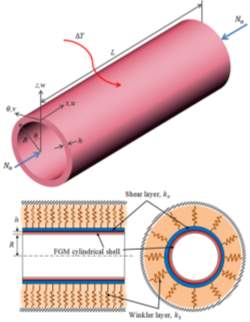
Fig. 1. The FG cylindrical shell on Pasternak elastic foundation under axial and thermal loads.
Based on the first order shear deformation theory, the displacements of any arbitrary point in the shell thickness could be expressed as:
Struggling to structure your research paper?
From thesis statement to conclusion, our research paper writers build strong, evidence-driven arguments using peer-reviewed sources. We cover APA, MLA, Harvard, and Chicago — undergraduate through doctoral level, across all disciplines.
✓ Plagiarism-free · ✓ 100% human · ✓ Free revisions · ✓ Confidential
🔒 No payment to start · From 3 hrs
| U=ux,θ,t+zψxx,θ,t , |
