
Management Consultancy Report Submission
Table of Contents
Section I: Industry and Organisational Drivers of Project Management
Section II: Alignment with Strategy
Section III: Project Lifecycle
Section IV: Organisational Structure
Section V: Project and Organisational Maturity
Section VI: People and Competency Development
Section VII: Stakeholder Analysis
✍️
Your thesis deserves more than a rushed draft.
Master's and doctoral thesis writing requires a defensible argument, rigorous methodology, and impeccable academic writing. Our thesis specialists have delivered 8,400+ model documents that passed committee review.
✓ Plagiarism-free · ✓ 100% human-written · ✓ Free revisions · ✓ Confidential
🔒 No payment to start · From $11/page
Executive Summary
This report presents an analysis of the New Product Introduction (NPI) Project Management capabilities in ProTek Medical. The analysis covers a review of the main drivers behind NPI Project Management Process in ProTek Medical, the alignment of the process to the company strategy, a review of the current project lifecycle, the structure of the project organisation, the maturity of the project management systems, the competency and development process of the project management personnel and an analysis of the current stakeholder identification and management processes.
The report is based on the author’s personal view of the project management practices but also draws on input from the primary Project Management professionals in the NPI team, gathered via questionnaires.
This review identified a number of deficiencies in almost each area examined and includes recommendations to address these deficiencies. The most notable issues identified included:
- Competency Development
Of the five (5) project personnel responsible for the management of projects in ProTek Medical none have received any significant training in Project Management to date but have acquired their knowledge through on the job learning.
Additionally there is no competency development process in place in ProTek Medical to develop the skills and capabilities of the project management personnel.
This report includes a number of recommendations to increase the competency of the project management personnel and to put in place a process for competency development.
- Maturity of the Project Management Systems
Utilizing the P3M3 Self-Assessment for Projects the maturity of the project management system was assessed to be a Level 2. This is deemed by the author to be insufficient and it is recommended to develop a plan to improve the overall maturity of the project management process.
- Stakeholder Management
Currently in ProTek Medical there is no formal system for stakeholder mapping or management. Given that the majority of high value projects undertaken by the project management team as for external customers this is seen as a significant deficiency and it is recommended to develop a system to ensure stakeholders are identified and managed in a more consistent way.
- Project Lifecycle
The scope of the project lifecycle is very limited and is focussed on getting projects “over the line” and contains a number of very obvious gaps such as benefits identification & realisation; stakeholder analysis…
Introduction
ProTek Medical (ProTek, PTM) is currently undergoing significant organisational and strategic change. ProTek Medical was acquired in June 2015 by Molex LLC (Molex), owned by Koch Industries (Koch) and has been undergoing integration into both Molex and Koch Industries since that time. In late-2016 Molex acquired Phillips-Medisize Corporation (Phillips-Medisize, PMC). As a result of this acquisition and the relative size of the Phillips-Medisize organisation, Phillips-Medisize became the Medical and Pharmaceutical Solutions Division of Molex with ProTek Medical reporting directly to Phillips-Medisize, US. The integration process has therefore changed to align ProTek Medical with Phillips-Medisize.
The introduction of new products into ProTek manufacturing is project managed by the New Product Introduction Department. The team is comprised of four Project Managers and additional support staff but also draws on specialised resources from the wider Functional Areas. Other common projects in ProTek, such as Continuous Improvement Projects are typically managed at a functional level but are outside the scope of this assessment.
This report is therefore based on the current NPI systems and processes within ProTek Medical taking into account the ongoing changes due to the integration process. Where Phillips-Medisize or Molex systems or processes are referenced these will be explicitly identified.
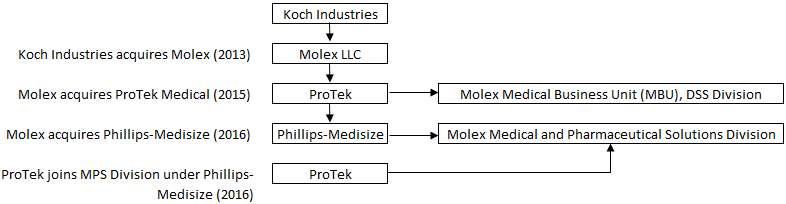
Image 1: Recent history of ProTek Medical’s position with respect to the acquisitions by Molex LLC.
Koch Industries, Inc. is a privately owner, multinational corporation with more than 120,000 employees in 60 countries and subsidiaries across a number of industry sectors including manufacturing, ranching and medical technology.
Molex LLC is a world leading manufacturer of electrical and fiber optic interconnection systems with products across a number of industries such as aerospace, defence, automotive, computing and medical.
Phillips-Medisize Corporation is a global leader in outsource design, development and technology-driven manufacturing for a variety of industries including automotive, defence and medical technology.
ProTek Medical is a 100% medical focussed contract manufacturer, specialising in manufacturing and assembly of custom products for Medical Device OEMs worldwide.
Section I: Industry and Organisational Drivers of Project Management
Industry & Organisational Drivers
ProTek Medical, being a medical device contractor and service provider, relies on a pipeline of New Product Introduction projects to maintain the viability of the business. Many of the products manufactured by ProTek have limited lifecycles, often reaching end of life within 5-10 years of launch. To continue to grow the business it is important that ProTek continues to develop and win new opportunities. Key to this is the effective performance of the NPI process which helps drive the company strategy in a competitive environment.
Drawing on the Seven Forces Model of Project Management (Turner 2007) the key drivers influencing the management of ProTek projects could be said to be:
- The customer who finances the projects, expects to achieve the defined benefits and who drives the urgency of the project.
- The competitive environment in which ProTek operates, with the need to provide superior value to its Competitors particularly in terms of Cost, Quality and Delivery or Service.
- The organisational governance which aligns ProTek’s projects with the Organisation’s strategy.
- The governance of the Regulatory and other Bodies ensuring compliance to ISO 13485, other relevant standards and ProTek’s own Quality Management System.
Additionally there are internal drivers which influence projects to a lesser degree such as the knowledge and skills of the project team members, leadership, technical capabilities and the Organisation’s systems and processes to name just a few.
Relative Priority of the PMBOK® Knowledge Areas
The ten PMBOK® Knowledge Areas, per the PMI Project Management Body of Knowledge 6th Edition, were reviewed and reflected upon by the Author to identify the relative priority placed on them in the Organisation. Additionally, the ProTek project management team were polled to provide further data for comparison.
To assess the relative priority of each Knowledge Area, following the review of the knowledge areas subjective scores out of ten were given to each knowledge area with the results tabulated in Table 1 below. The scoring, though subjective, is intended to aid in identifying the knowledge areas which receive the greatest attention within a typical NPI project in the Organisation. The author’s assessment and scoring rationale is attached in the Appendix.
Note: The Project Management team members polled have not received any formal training on the knowledge areas to date. This lack of familiarity resulted in a very wide variation in poll results rendering the data unreliable for this assessment.
| Knowledge Areas | Author | |
