
Financial Reporting and Analysis of: Citrix Systems, Inc.
Stock symbol: CTXS (NASDAQ)
Table of Contents
RETURN ON EQUITY DECOMPOSITION
✅
Complex assessment task? We know what markers reward.
Our assessment specialists decode your marking rubric and deliver model answers targeting distinction criteria — written, practical, and portfolio assessments at US, UK, Australian, and Canadian universities.
✓ Plagiarism-free · ✓ 100% human-written · ✓ Free revisions · ✓ Confidential
🔒 No payment to start · From $11/page
DISCOUNTED ABNORMAL RETURN ON EQUITY
EARNINGS GROWTH (BUFFETT’S MODEL)
CALCULATION OF ALTMAN Z-SCORE MODEL
APPENDIX ………………………………………………………………………………………………………….……………………57
Citrix Systems, Inc. (“Citrix”) is in the business of providing virtualization, networking and cloud infrastructure solutions to consumers who aim to influence a world where individuals, organizations, and items are securely linked and easily accessible to make the extraordinary possible. They are disrupting their industry by accelerating change in their industry and providing clients solutions to reimagining the future of how they work.
Rapid technology innovation, coupled with a generational shift in the workplace as Millennials replace Baby Boomers, has motivated Citrix to adapt to changing times and adjust their strategy. Workforces have become increasingly demanding of more agile, productive and resourceful tools to provide their employees flexibility while facilitating productivity and promoting a positive worker experience.
Based on a comprehensive analysis of Strategy, Accounting, Financial, Credit and Prospective analysis of Citrix Systems, we believe the stock it is overvalued at current price levels and our recommendation is a “HOLD. The financial health and growth prospects of Citrix, demonstrate its potential to outperform the market but as the management continues to focus on redefining its product offering and divest from non-profitable business units. At its core business, it shows good signs of strength and viability at 15.3% growth compared to 10.9% of the industry.
STRATEGIC ANALYSIS
COMPANY OVERVIEW
Citrix Systems, Inc. is one of the leading company of its industry, founded in 1989 by former IBM developer Edward Iacobucci. The multinational US-based software firm originated in Richardson, Texas. Later that same year, it was relocated to Mr. Iacobucci’s hometown of Ft. Lauderdale, Florida. Subsidiary operations have been established in California and Massachusetts, with additional centers located worldwide in Australia, Canada, Denmark, Germany, India, and the United Kingdom. As of December 31, 2017, the company employs 8,100 employees worldwide.
Although the company was first introduced as Citrus Systems, a trademarked dispute arise and forced the company to officially change their name to Citrix. In its early days, the company continued to develop their ‘Citrix Multiuser’, which was created to support the OS/2 Microsoft package by allowing multiple users remote access[1]. Today, the company offers a complete and integrated portfolio including application delivery, virtualization, mobility, network delivery and file sharing solution technology that makes applications and data secure and easy to access, empowering people to work anywhere and at any time. In order to encourage employees in promoting growth in trying new ideas and staying current with the times, they added two fundamental practices, ‘curiosity’ and ‘courage’, to their company core values. [2]
Services that cover every part of your degree
All subjects · All levels · All deadlines
Citrix functions through two business segments: the enterprise and service provider, and mobility applications. The enterprise and service provider segment include workspace services, delivery networking products and related license updates, and maintenance and professional services. The company wants to connect people, organizations and things securely and empower them to make the extraordinary possible.[3]
INDUSTRY ANALYSIS
Companies in this industry design and publish computer software. The global information technology industry surpassed $4.5 trillion in 2017, according to the research consultancy IDC. If growth expectations materialize in the year ahead, spending will surpass the $4.8 trillion mark.[4] The Computer Software & Services Industry includes a broad range of companies, offering an extensive range of products and services, spanning personal computer operating systems and office productivity suites to network security applications to payroll processing services to information technology consulting and outsourcing services. Digital transformation is occurring in every industry at a rapid pace.
As stated in Deloitte’s Challenges and solutions for the digital transformation and use of exponential technologies report, the software and services sector is responsive to the needs and opportunities of an increasingly connected and mobile society. The software and services sector is responsive to the needs and opportunities of an increasingly connected and mobile society. The rise of the internet, as well as the continued growth of access around the world, has allowed the Software and Service sector to position itself as an enabler of communication and information. Product and service innovation is focused on increasing mobility, offering large and complex data sets, cloud computing, the virtualization of data centers and helping customers reduce their environmental footprint. Gradually, emerging markets are accounting for an important share of the services these companies provide, as well as being the home to some of these firms.[5]
Important innovations are making cloud computing even more valuable for companies as they seek to transform their operations and business models. These advances are helping organizations accelerate deployments of artificial intelligence and Internet of Things solutions, while also enabling deep, analytics-driven insights and accelerated software delivery.[6]
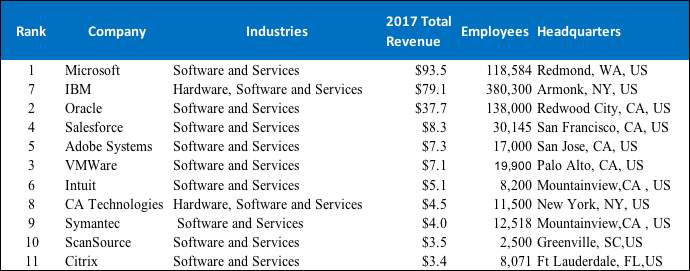
Figure 1 Fortune Global 500 Technology Companies
In order to enable growth and to keep up with the complexities and unyielding pace of digital transformation, companies are buying or partnering with other companies in order to pool their resources for mutual gain in areas where they don’t compete directly.
In order to facilitate growth and to keep up with the complexities and relentless pace of digital transformation, companies are buying or partnering with other companies in order to pool their resources for mutual gain in areas where they don’t compete directly.
In today’s fast-changing technology marketplace, it has become imperative to recognize where new, disruptive technologies are emerging.
COMPETITIVE ENVIRONMENT
Technology is fast disrupting various industries across the board. Traditional software and internet companies have become key players in the business transformation for many industries. Innovation has enticed leading competitors looking to continue growth, increase operational performance and gains to develop more intrinsic creative software.
Michael Porter developed the Five Forces Analysis Model to examine an industry’s competitive and economic structures.[7] The five forces are as follows:
- Bargaining power of buyers
- Bargaining power of suppliers
- Threat of new entrants
- Threat of substitute products or services
- Rivalry among existing competitors
Bargaining power of buyers
Citrix needs to continue satisfying customers, who significantly determine the company’s performance. Buyers increase competition within an industry by forcing down prices, bargaining for improved quality or more services, and playing competitors against each other to obtain better prices. Readily available access to information about product features and prices further empowers buyers as they can use that information to compare Citrix products to competitors. This excels pressure on Citrix Systems, Inc. profitability in the long run.
Bargaining power of Suppliers
Bargaining power of suppliers can raise prices or reduce the quality of products or services. Due to the intensification of the competition in the marketplace, the bargaining power of suppliers among many industries has decreased. For Citrix, the supplier bargaining power is low because the information technology industry, and hardware and software segment is highly competitive, and a large number of companies and suppliers operate in this industry.
Threat of new entrants
New entrants bring innovation and diverse ways of doing things, which puts pressure on Citrix to find ways to continue to improve their price, cost, and quality. It is difficult to enter this industry because of the number of financial resources required for entering the industry. Investment of large capital in Research and Development is essential in order to remain competitive and continue to create innovative products. Entry into this industry is not uncommon, but its competitive nature requires the newcomer to be able to sustain a technological and product marketing edge over its larger rivals. If successful, the new entrant can grow very quickly. However, in the end, it may find itself an acquisition target if it is unable to reach large enough scale.
Threat of substitute products or services
The substitute products and services is considered a major factor for companies as it impacts the overall competitive environment within the industry. For Citrix, the threat of substitute products and services is low because the range of direct and indirect substitution for the types of services offered by the company that includes application virtualization software, network access devices, cloud computing connectivity, and mobile applications and a wide range of software applications is very limited.
Rivalry among the Existing Competitors
The intensity of rivalry among industry players is fierce. Companies are constantly putting pressure on one another and limit each other’s profitability. Citrix is repositioning itself for future growth by redlining their core business. It has streamlined their product portfolio and it is focusing on two segments that generate the most revenue: workspace services and delivery networking.
REGULATORY ELEMENTS
The regulatory trends affecting the software and services sector are related to consumer data privacy and security, and intellectual property (IP) rights, issues that, due to rapid technological change, legal oversight is struggling to keep up with. There has been an ongoing global debate concerning these issues and recently, the U.S. and European Union have taken some steps to introduce regulatory changes.
COMPETITIVE ADVANTAGE
CITRIX SYSTEMS INC Is benchmark against industry averages and competitors, including:
Microsoft Corporation
IBM
Oracle Corporation
Salesforce
Adobe Systems
VMware Inc
Intuit
CA Technologies
ScanSource
Symantec
Developing purpose-built products from the ground up is fundamental to the company’s culture of meeting customer needs. Every Citrix product is designed to deliver exceptional reliability, speed, security, and ease of use while being affordable to businesses of all sizes. This appealing combination of simplicity and cost-effective pricing enables the company to enjoy widespread adoption of its product offerings.
Flexible work environments better align work policies to the lives and values of employees. As a result, employees become more engaged and productive. However, providing this kind of flexibility introduces new security and management challenges. To stay ahead, employers will need to find new strategies for managing and securing their technology infrastructure.
Citrix Systems became the leader in Workspace as a Service (WaaS) by delivering the industry’s most secure platform, data, network, and delivered services in their Cloud. Citrix is well positioned for continued sturdy growth. Its collection of solutions enables businesses to fundamentally change their economies by allowing them to innovate, extend their reach and productivity and drive higher ROI. The company is uniquely positioned for long-term changes in the workplace. Its remote access and collaboration services free businesses to work from anywhere, providing employers and employees alike with significant advantages in productivity, cost savings and job satisfaction.
SWOT ANALYSIS
SWOT analysis is a strategic planning tool that can be used by a company to perform a situational analysis of the company. Citrix continues its leading position in the market by critically studying and evaluating their SWOT analysis. This analysis proves to be a handy means in understanding the company’s Strengths (S), Weakness (W), Opportunities (O) & Threats (T) Citrix faces in its current business environment.
The core purpose of SWOT matrix is to identify the strategies that a company can utilize to exploit external opportunities, counter threats, and build on & protect Citrix Systems strengths, and eradicate its weaknesses.
STRENGTHS
As one of the leading companies in its industry, Citrix Systems has numerous strengths that help the company protect market share while also letting it continue to thrive in the marketplace.
- Strong cash flow.
- Increased investment in Research & Development.
- The company sells directly to the consumer, saving om retailers margin while still also selling to resellers, to reach a large diversified market.
- Strong network of suppliers and distributors.
- Strong online service segment, easily accessible by end users, with an option to easily customize package requests.
- Excellent Supply Chain Management, helping to reduce operational cost.
- Has company centers worldwide, including Australia, Canada, Denmark, Germany, India, and the United Kingdom with 8,1000 strong workforces.
WEAKNESS
Weakness, or internal strategic factors, where Citrix can improve upon to keep their competitive advantage and strategic positioning include:
- High inventory days, and low inventory turnover due to their inefficient demand forecasting.
- Supplier issues causing a few operational issues.
- Need for more innovation and new technology investment to stay a competitive industry leader outside of core business.
- More controlled global dispersion and higher days in inventory as compared to a few other leading companies due to poor forecasting.
OPPORTUNITIES
Opportunities or external strategic factors, where Citrix is able to grow and dominate more market while attracting higher gains include:
- Strategic mergers and acquisitions.
- Technology partnerships to enhance technology and market positioning.
- Growing virtualization market.
- Manufacturing and marketing low-cost, unbranded low-price PCs.
- New online platform investments geared to attract more online consumers.
- Expected increased revenues due to new consumer work trend requests.
THREATS
Threats, other external strategic factors, Citrix needs to take into consideration in order to stay a leading company includes:
- Intense growing market competition.
- Competitor counterfeit low-quality imitation of products.
- Threat of new competitor offering more affordable value propositions.
- Fluctuation in the currency due to operating in multiple countries.
VALUES OF KEY PERSONNEL
Increased turnover of multiple senior-level members of management has created uncertainty and instability for Citrix in the last three years. In several cases, these valuable managers have left to join Citrix’s direct competitors. As one of the main priorities of Citrix management, initiatives were created to retain, and recruit top talent was implemented.
Citrix is committed to connecting and engaging employees and customers. Citrix states in its Code of Business Conduct that it “values employee diversity and equal opportunity for all”. They encourage innovative ways of doing things and continuously look for new young blood. Diversity and inclusion are utilized to leverage the power of human difference for good.
According to Donna Kimmel, SVP Chief People Officer at Citrix, “Even as technology continues its breathtaking pace of innovation, nothing can replace the empathy, creativity, and potential of the people in your organization”. By being open to learning new things, challenging limits, failing fast and learning continuously, employees will be better enabled to thrive in a future of work characterized by smart machines and big data. Citrix believes when employees are given the space to make meaningful contributions at work, they become more purposeful not only in their daily tasks but in their careers.
Employees take pride in the company’s relentless technological innovation, commitment to cybersecurity and the opportunities it creates for their customers. The company’s vision of Corporate Citizenship is to help people work better and live better Citrix acknowledges that it “is rapidly expanding its business every day” and that its responsibility to be a global corporate citizen has grown.
ACCOUNTING ANALYSIS
Citrix’s annual report outlines all of its accounting policies in support of their financial statements. In a review of their accounting policies, we compared their methods with their competitors (Oracle, VMWare, and Microsoft) and concluded that majority of Citrix’s reporting methods are similar to their competitors. The closest in comparison in similarities is VMWare’s, while Microsoft and Oracle are much more specific in their reporting. Below is a comparison table between Citrix and their competitors. For more details about their accounting policies, we’ve included in the appendix at the end of this report.
