
ABSTRACT
This main purpose of this thesis is to investigate the principles connected to the construction of a passive house and to determine the viability of the passive house concept in Ireland.
Passive house is the result of the further development of the low energy house, it’s a performance based energy standard for building. Passive Houses use on average 90% less energy for space conditioning than code-designed houses.
Over the past decade there has been an increasing effort to reduce the amounts of carbon dioxide. With homes being one of the biggest contributors of carbon dioxide and with recent (EIA) Energy Information Administration survey showing that since 1950 there has been an increase in carbon dioxide emissions associated with residential homes.
It is therefore no surprise that there is a greater interest today in how homes preform in regards to energy consumption.
As part of an ongoing program to improve the quality of Irish housing, as well as decreasing
Ireland’s energy demand and carbon emissions as part of Irelands Kyoto protocol target, the Irish building regulations have gone through a lot of change in recent years. It is the current
government’s intention that by 2020 legislation will have brought Ireland to the point where
all new housing is zero-carbon low energy housing
The purpose of this thesis research is firstly to provide a detail understanding of the main concepts of passive housing by highlighting the fundamental requirements connected with low energy design and construction. Secondly to provide an understanding of the viability of passive housing and relevance of passive housing standards in Ireland today.
By means of critically accessing literature and through primary research by the means of an online questionnaire, the theme of this thesis is considered throughout this report.
Drawings and charts obtained from this research, as well as the benefits and problems associated with passive houses will be discussed and outlined.
TABLE OF CONTENTS
1.5.2 Chapter 2: Literature Review
1.5.3 Chapter 3: Research Design and Methodology
1.5.5 Chapter 5: Data analysis
1.5.6 Chapter 6: Research Findings
1.5.7 Chapter 7: Conclusions and recommendations
2.3.2 Passive House In Ireland
2.4 Passive House Certification
2.6 Passive House “Construction Techniques”
2.9 Barries To Development Of PH In Ireland
2. 10 Irish Building Regulations 2011: Part L
CHAPTER 3. RESEARCH METHODOLOGY
3.4.1 Approaches To Data Collection
3.4.2 Data Colletion – Case Study
3.4.3 Data Collection Questionnaire
3.4.4 Target / Selected Sample
International student? We write to your country's academic standard.
From Harvard referencing for UK universities to APA 7th for US colleges, our geo-specialist writers know exactly what professors in your country expect. Deadlines from 3 hours. 100% original. Confidential and secure.
✓ Plagiarism-free · ✓ 100% human · ✓ Free revisions · ✓ Confidential
🔒 No payment to start · From 3 hrs
CHAPTER 5. DATA ANALYSIS FOR QUESTIONNAIRE
6.4 Developmen Of Passive House In Ireland
CHAPTER 7. CONCLUSION AND RECOMMENDATIONS
7.2 Research Aims And Objectives
Appendix A – Online Questionnaire
LIST OF FIGURES
Figure 1: The Research Ship “Fram” was a Passive House (PASSIPEDIA, 1998)
Figure 2: “Out of the blue” – Irelands first certified PH (ARCHITECTURE, 2007)
Figure 4: Application of various types of insulation (Ebbs, 2012)
Figure 6: Typical Heat Recovery Ventilation System
Figure 7: Heat losses related to the airtightness level n50 (Saint Gobin)
Figure 10: Window Certified by Passive House Institute (2006)
Figure 11: Solar Power Per Capita & Wind Power Per Capita Leaders (Shahan, 2015)
Figure 12: Schematic of Solar Water Heating System (REUK.co.uk, 2017)
Figure 13: Annual end-use energy consumption
Figure 14: Specific Energy Consumption (Jennings, 2005)
Figure 15: Comparison of yearly energy consumption rate. (Ebbs, 2012)
Figure 16: Calculated Energy and CO2 emissions for 100m2 Irish dwelling
Figure 17: Various stages in composition of dissertation
Figure 18: Pragmatic approach to research. (Creswell, 2003)
Figure 20: ‘Out of the Blue’ First Floor (Antonelli, 2014)
Figure 21: ‘Out of the Blue’ Ground Floor (MosArt Architecture, 2012)
Figure 22: ‘Out of the Blue’ Passive House – Construction Stage. (MosArt Architecture, 2012)
Figure 23: Schock Novomur Insulated Bock – Construction Stage (Marlok, 2014)
Figure 24: Triple Glazed Section Unit (MosArt Architecture, 2012)
Figure 25:Window Components (MosArt Architecture, 2012)
Figure 26: Floor Components (MosArt Architecture, 2012)
Figure 27: Wood Pellet Stove in ‘Out of The Blue’ (O’Se, 2010)
Figure 28:Radiators used in ‘Out of the Blue (O’Se, 2010)’
Figure 29: Questionnaire Respondents (Total number = 31)
Figure 30: Experience of Respondents ( Total number = 31)
Figure 31: Question 1 – Online Questionnaire
Figure 32: Question 2 – Online Questionnaire
Figure 33: Question 3 – Online Questionnaire
Figure 34: Question 4 – Online Questionnaire
International student? We write to your country's academic standard.
From Harvard referencing for UK universities to APA 7th for US colleges, our geo-specialist writers know exactly what professors in your country expect. Deadlines from 3 hours. 100% original. Confidential and secure.
✓ Plagiarism-free · ✓ 100% human · ✓ Free revisions · ✓ Confidential
🔒 No payment to start · From 3 hrs
Figure 35: Question 5 – Online Questionnaire
Figure 36: Question 6 – Online Questionnaire
Figure 37: Question 7 – Online Questionnaire
Figure 38: Question 8 – Online Questionnaire
Figure 39: Question 9 – Online Questionnaire
Figure 40: Questions 10 & 11 – Online Questionnaire
Figure 41: Question 12 – Online Questionnaire
Figure 42: Question 13 – Online Questionnaire
Figure 43: Question 14 – Online Questionnaire
Figure 44: Question 16 – Online Questionnaire
Figure 45: ‘Out of the Blue’ Passive House – Ireland’s
Figure 46: ‘Out of the Blue’ Passive House – Thermal Mass
Figure 47: MHRV for ‘Out of the Blue Passive House
Figure 48: Aperture area Solar Panels
Figure 49: Triple glazed window being installed in Out of the Blue’ Passive House
Figure 50: Airtight window – ‘Out of the Blue’ Passive House
LIST OF TABLES
Table 1: : Potential for space heating energy and carbon dioxide savings. (SEAI, 2007, p. 8)
Table 2: Technical Definition of the Passive House Standard for Ireland. (SEAI, 2007)
Table 3: Material Suitable to meet PH Standard U-value of 0.13 W/ (m²K). (Passipedia, 2017)
Table 4: Breakdown of respondents opinions
Table 5: Question 14 – Online Survey
LIST OF ABBREVIATIONS
BER- Building Energy Rating
CEPHEUS- Cost Efficient Passive Houses as European Standard
CIF- Construction Industry Federation
CO2- Carbon Dioxide
CPHD- Certified Passive House Designer
DEAP- Dwelling Energy Assessment Procedure
EPC – Energy Performance Coefficient
DIT- Dublin Institute of Technology
EPBD- European Performance of Buildings Directive
H&S- Health & Safety
IPHT- Institute of Passive House Training
M&E- Mechanical & Electrical
MHRV- Mechanical Heat Recovery Ventilation
m 3 /h/m2 – meters cubed per hour per square meter
kWh/m2 /yr- Kilowatt hours per square meter of floor area per year
Pa- Pascal
PH- Passive House
PHA- Passive House Academy
PHI – Passivhaus Institute
PHPP – Passive House Planning Package
PEPH – Promotion of European Passive Houses
IPHA- International Passive House Association
SEI- Sustainable Energy Ireland
SEAI- Sustainable Energy Authority of Ireland
TGD- Technical Guidance Document
TGD L- Technical Guidance Document Part L (Irish Building Regulations)
UK- United Kingdom
USA- United States of America
UCD- University College Dublin
W/m2K – U-value (the rate at which heats flows through building fabric)
Chapter 1. Introduction
1.1 INDTODUCTION
The Celtic Tiger is the name given to the unique but unexpected economic growth in Ireland from the mid 1990’s to 2007. The construction industry was a large driving force of the economic boom, many truths about long-term damage which can be done by uncontrolled economic growth are beginning to surface.
The enforcements of regulations during the Celtic Tiger was unnoticed and unheeded, this meant that new houses that were built did not perform well energetically with heat loss due to badly installed insulation and due to a lack of air tightness being achieved.
International student? We write to your country's academic standard.
From Harvard referencing for UK universities to APA 7th for US colleges, our geo-specialist writers know exactly what professors in your country expect. Deadlines from 3 hours. 100% original. Confidential and secure.
✓ Plagiarism-free · ✓ 100% human · ✓ Free revisions · ✓ Confidential
🔒 No payment to start · From 3 hrs
This not only has a negative effect on the thermal comfort of the house but also the cost of maintaining temperatures in the house.
This is added to the fact that there are already existing older houses, the majority of which would perform very badly in a Building Energy Rating (BER) test.
For the last number of years, the Passive House standard for building a house has been implemented greatly across many parts of Europe, it has been seen as a way to counter the rising fuel costs and to provide sustainable housing.
The planning that is required for such housing is vastly detailed with the main contributors to its effectiveness being passive solar gain, building orientation and building form.
Ireland also has an issue to when it comes to CO2 emissions, this was another key factor to why the new building regulations were introduced as it is currently the government’s intention that by 2020 legislation will have brought Ireland to the point where all new housing is zero-carbon low energy housing.
In 2007 a report of the Inter-Governmental Panel on Climate Change
(IPCC) shows that climate change is already a very serious global issue. Discusses how it will have a negative effect on the ecosystem, the economy and on living conditions are anticipated to be on a massive scale.
Passive House also plays a key role in reducing the impact of global warming, according to Sustainable Energy Ireland (SEAI) ‘’Ireland’s mild climate puts it in a favourable position to introduce Passive Houses to mainstream construction compared to the more severe climates prevalent in central Europe’’
1.2 SCOPE
The main scope of this dissertation is to investigate the passive house concept as a model for the sustainable construction of homes in Ireland and the benefits and limitations of applying the passive house standards to homes in Ireland.
This dissertation examines and investigates Passive House as a suitable building method for use in Ireland to provide a sustainable home.
1.3 RESEARCH RETAINABLE
There are a number of factors under consideration in this document. These are as follows:
In Ireland
- There is also a need to assess if the use of Passive House will help to produce more sustainable buildings and assist Ireland in meeting its obligations to reduce energy consumption and CO2 emissions by 2020
- The current EU legislation regarding the need for energy consumption means Ireland has to achieve strict targets. Energy consumption must be reduced by 20% by 2020 (CIF, 2013) With the above in mind there is a need for all involved in the Irish construction industry to focus on the procurement of sustainable buildings and materials.
- Technical Guidance Document (TGD) Part L of the Irish Building Regulations aim to
achieve 60% aggregate improvements over the 2007 standards in both the energy performance and associated carbon emissions of new dwellings from 1 December 2011. Given that residential energy represents over a quarter of final energy use, the framework underpinning these targets has massive potential for Ireland.
1.3 RESEARCH AIMS
The main scope of this dissertation is to investigate the passive house concept as a model for the sustainable construction of homes in Ireland.
1.4 RESEARCH OBJECTIVES
- Review of the Passive House design criteria for a residential dwelling.
- To identify the principles and requirements of residential Passive Housing in Ireland.
- An examination of the current Irish building regulations and the standards required by the Passive House Institute.
- A closer look at the current Building Regulations Part L relating to Conservation of Fuel and Energy.
- A search for any existing certified passive houses in Ireland or houses built to the Passive House standard.
- To establish the level of knowledge construction professionals have of the Passive House concept.
- Recommending further work which could be carried out to improve on this study and highlighting related areas of interest which warrant further investigation.
1.5 SUMMARY OF CHAPTERS
1.5.1 Chapter 1: Introduction
This chapter provides an introduction to the document, outlines the aims and objectives of the document. It also provides an overview of the contents of the dissertation.
1.5.2 Chapter 2: Literature Review
This chapter examines already published information on the topic. This includes a comprehensive review of the Passive house concept and a brief review of the evolution of the Passive house standards. This chapter also provides a detailed investigation of the exact criteria required to meet passive house standards such as quality control, insulation, thermal bridging, air tightness, ventilation, energy efficiency, thermal comfort.
1.5.3 Chapter 3: Research Design and Methodology
This chapter provides an explanation of the research methods that were used. This includes a review of primary and secondary data as well as qualitative and quantitative research methods.
1.5.4 Chapter 4: Case Studies
This chapter will examine relevant case study and to look at the key aspects of it in relation to the Passive House concept.
1.5.5 Chapter 5: Data analysis
This chapter analyses the data obtained from the structured online interviews of industry professionals. Industry professionals were surveyed to gain a measure of their knowledge and attitude towards sustainable construction and the use of Passive House as a means to meet the Technical Guidance Document (TGD) Part L of the Irish Building Regulations.
1.5.6 Chapter 6: Research Findings
This chapter will present the findings of the data received and all the information obtained throughout the project. The data received is examined and summarised.
1.5.7 Chapter 7: Conclusions and recommendations
This chapter presents the conclusions and recommendations arising from the research.
Chapter 2. Literature Review
2.0 LITERATURE REVIEW
2.1 INTRODUCTION
This literature review seeks to examine and investigate the main elements associated with Passive Houses (PH).
The PH standard has been used in Ireland for a number but it is still relatively new and is very complex. This chapter will investigate the key concept and the history of Passive House and the criteria or standards required, this includes topics such as thermal quality control, insulation, thermal bridging, airtightness, windows and ventilation. Furthermore, discussions on the current 2011 Irish Building Regulations specifically Part L of the Regulations.
2.2 PASSIVE HOUSE CONCEPT
Passive House is a scientific tool which sets a standard to achieve exceptional comfortable and healthy living conditions. Waljen (Waltjen, 2009, p. 14) defines a Passive House (PH) as ‘a building in which thermal comfort is solely guaranteed by-reheating (or re-cooling) the volume of fresh air that is required for satisfactory air quality – without using circulation air’
The Passive House techniques works for both new and refurbished buildings of all types and sizes. The PH method has been tested throughout Europe, US, Canada and even in hot Asian climates with most seen as successful. The design technique first commenced in the central European climate with its cold and windy winters but through performance monitoring it’s been shown that PH is best suited to the milder climate of the British Isles. (SEAI, 2007)
The international ISO 7730 (ISO, 2005) describes PH as a building in which thermal comfort can be provided by post heating or cooling of the fresh air flow that is required for good indoor air quality.
A PH is a building in which a comfortable interior climate can be maintained without active heating and cooling systems according to (adamson 1987 and feist 1988). There is strong emphasis in this definition in regards to comfort and reheating of fresh uncontrolled air.
PH does not require the use of central heating system. Heat demand can be satisfied through a small heater that is integrated into the Mechanical Ventilation Heat Recovery (MVHR) system. The MVHR system is utilised to provide excellent air quality and highly efficient heat recovery.
In essence, a Passivhaus is “a building in which a comfortable interior climate can be maintained without active heating and cooling systems”(Fiest, 1988)
PH standard aims to achieve good comfort during winter and summer, without traditional space heating systems and without active cooling need to have not only good indoor air quality maintained by a mechanical ventilation system with highly efficient heat recovery but optimised insulation levels with minimal thermal bridges, very low air-leakage through the building, utilisation of passive solar and internal gains and good indoor air quality maintained by a mechanical ventilation system with highly efficient heat recovery. Renewable energy sources are used as much as possible to meet the resulting energy demand.
2.3 HISTORY OF PASSIVE HOUSE
In the middle ages, especially in Island houses were built mainly from turf, this was because wood became scarce after forests of Europe had been mostly destroyed for firewood and agriculture. The turf walls were built very thick for stability and these walls were found to have good insulating qualities so very little heating was required.
These Icelandic homes were a very simple form of PH even although they didn’t have adequate windows or sufficient ventilation.
The first ever functioning PH was not a house but a polar ship. It was not seen then as PH but in hindsight the techniques used were like the PH standards used today. Fridtjof Nansen, the owner of the ship who was to travel to the North pole wanted to build a ship that would enable the crew of the sip to survive in temperatures up to minus 22°, he writes:
“The sides of the ship were lined with tarred felt, then came a space with cork padding, next a deal panelling, then a thick layer of felt, next air-tight linoleum, and last of all an inner panelling. The ceiling of the saloon and cabins . . . gave a total thickness of about 15 inches. …The skylight which was most exposed to the cold was protected by three panes of glass one within the other, and in various other ways. … The Fram is a comfortable abode. Whether the thermometer stands at 22° above zero or at 22° below it, we have no fire in the stove. The ventilation is excellent, especially since we rigged up the air sail, which sends a whole winter‘s cold in through the ventilator; yet in spite of this we sit here warm and comfortable, with only a lamp burning. I am thinking of having the stove removed altogether; it is only in the way “ (PASSIPEDIA, 1998)
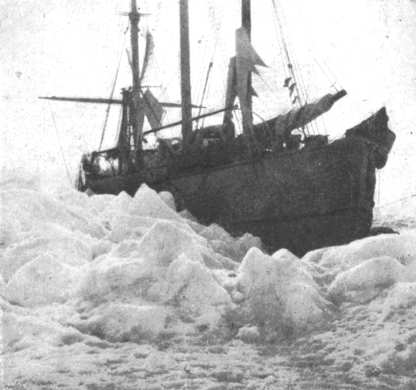
Figure 1: The Research Ship “Fram” was a Passive House (PASSIPEDIA, 1998)
However the PH standard was born in 1988 by two men called Professor Bo Adamson of Lund University, Sweden, and Dr Wolfgang Feist of the Institute for Housing and the Environment. They were great believers in low energy buildings and the key role it could play in building design but relised that more development in key ideologies for low eneregy housing was required. In order to test the practical fesability of the PH concept a number of pilot PH were designed most noterability the Kranichstein PH in Darmstadt, Germany.
The first PH homes comprised of four terraced houses which became the first occupied multi family home to attain a heating energy consumption of 12kWh/(m2a) considering the standard home in 1990 achieved just 10% better. The energy monitering performance proved that the PH startegy was successful in relation to low energy consumption. The net energy consumption across the four homes (space heating + domestic hot water +electricity) showed that the buildings required very little heating (below 10 w/m2). Dr Feist in his thesis states how he was so happy with the the success of the PH and his objective of this development was to set a stage as a model of low energy homes that could be constructed at a resonable cost.
In 1996 an independent research organisation was founded, The Passive House Institute (PHI), to promote and control the Passive House standard and has played a crucial role in the development of the Passive House concept (Fiest, 1988) (Bere, 2013)
2.3.1 CEPHEUS
Building on the success of the pilot scheme a new programe was brought in to meet energy challenges called CEPHEUS. The Cost Efficient Passive House as European Standards (CEPHEUS) was a strategy which aimed to improve the energy efficiency of homes throughout Europe. The CEPHEUS project ran from 1998 to 2001 and involved the construction of 250 houses built to PH standard across five Europen countries, Germany, France, Austria, Sweeden and Switzerland. The in-use energy of these homes was monitered and the results showed that it had achieved its goals in a majority of the sub-projects. The avaeage heat demand found was 16.6 Wh/m2/yr. The extra cost of construction of the unit was seen to be less than 10% above above what the normal applicable requirements for that region was. The project also paid close attention to user comfort and it was recorded in the results which showed a high level of user acceptance to PH.
The CEPHEUS project is seen as a major influence in the promotion and growth of PH standard across Europen including Ireland where in 2007 Duncan Steward, from RTE television show About the House, took a visit to one of the CEPHEUS projects in Goteborg, Sweden. (Bere, 2013) (RTE TV)
2.3.2 PASSIVE HOUSE IN IRELAND
In 1997 an agreenment called Kyoto Protocol came into effect with the propoosed effect of reducing the Co2 emmisions in Ireland by up to 13%. It is an agreement under which the industrialised countries will reduce their collective Co2 emissions of greenhouse gases.
Ireland together with 160 other countries committed to the Kyoto Protocol. It is a legal binding commitment to reduce the amount of greenhouse gases over an agreed period. Ireland had agreed to limit its emissions by 13% between 2008 -2012 and due to the recession that hit Ireland it helped Ireland to meet its Kyoto targets by the end of 2012. Irelands Kyoto target now is to reduce Co2 emmisions by 20% by 2020.
This was one of the main reasons why PH came into Ireland. The first time PH was introduced into Ireland was by Architect Tomas O’Leary in 2000. At this time Tomas attended the ‘’see the light conference’’ in Kerry where the PH concept was introduced into Ireland. The house was built in County Wicklow and the house was aptly named “Out of the Blue” as the sky provides a majority of the heat demand for the house. (Rose, 2015)
Today the PH has become a worldwide building strategy and a generic term to describe low energy buildings. As of 2014 there are estimated to be 40,000 buildings certifed to the PH standard and many more inspired by the PH model concept.
In Ireland there are around nine PH certified by PHI and approxamenely 50 projects so far which have been completed in Ireland both new builds and retrofits. (Rose, 2015) (Ebbs, 2012)
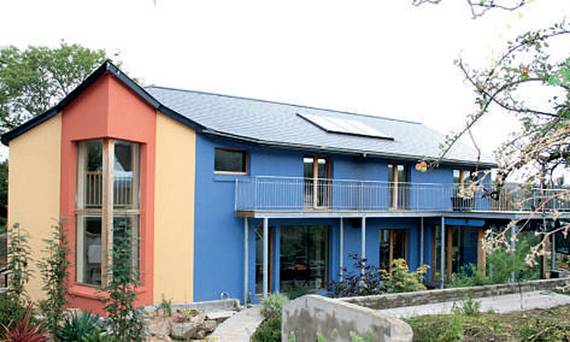
Figure 2: “Out of the blue” – Irelands first certified PH (ARCHITECTURE, 2007)
UCD Energy Group (2008) carried out a study to analysis the existing housing stock in Ireland and calculated figures for energy required for space heating and carbon emission savings which could be achieved if the PH Standard was implemented. The study found that houses which were built in 2002 using the 2002 building regulation standards consumed on average 9,722kWh/year delivered energy on space heating and as a result emitting 2,855 kgCO2/year into the atmosphere. The exact same dwelling built to PH Standard was found to be only 1.500kWh/year of delivered energy, emitting 176 kgCO2/year.
Based on an estimated average of 40,000 homes built per year over a 20-year period, potential energy and CO2 emissions saving rates were calculated. The results show that substantial savings are achieved by using the PH Standard in Ireland. (SEAI, 2007, p. 8)
| Percentage (and number) of new dwellings built to Passive House Standard | Potential energy and CO2 emissions savings per year | Potential energy and CO2 emissions savings in 20 years |
| 1% (400) | 3.29 GWh | 0.691 TWh |
| 1.07 ktCO2 | 5.02 MtCO2 | |
| 5% (2,000) | 16.44 GWh | 3.453 TWh |
| 5.36 ktCO2 | 25.10 MtCO2 | |
| 20%(8,000) | 65.78 GWh | 13.813 TWh |
| 21.44 ktCO2 | 100.41 MtCO2 | |
| 50% (20,000) | 164.44 GWh | 34.533 TWh |
| 53.59 ktCO2 | 251.03 MtCO2 |
Table 1: : Potential for space heating energy and carbon dioxide savings. (SEAI, 2007, p. 8)
The impact of this research is shown in figure 3 below, which shows the yearly savings which could be made by implementing the PH Standard as Building Regulations in Ireland.
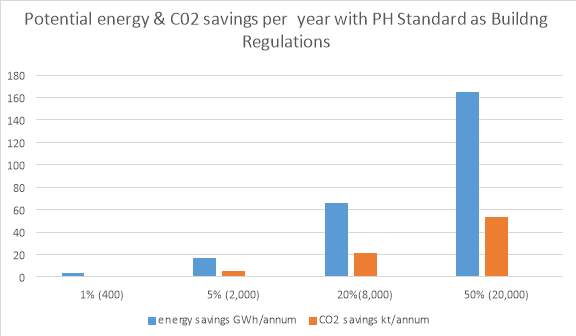
Figure 3: Potential energy and CO2 savings to be made by implementation of the Passivhaus standard as Irish Building Regulations (SEAI, 2007)
2.4 PASSIVE HOUSE CERTIFICATION
To be fully eligible and to have the status of PH certification, it must be received from the Passive House Institute in Darmstadt, Germany. Over the last number of years, a small number of Irish companies have become registered PH Institute partners and through this partnership can award genuine PH Institute certifications, subject to meeting the required criteria and PH standards.
In 1998 a computer software package called PHPP (Passive House Planning Package) was developed by the Passive House Institute (PHI). This package was developed to enable designers and builders to calculate the energy demand of a building and to ensure that the building meets the PH standards and the required design criteria. Since its inception in 1998 the PHPP program package has been developed on a continuous basis. There are currently several Irish companies using this programme including MosArt Architecture in Wexford, PH builders Vikings Hose in Dublin and Scandinavian Homes in Moycullen Galway.
In order for certification construction drawings must be provided, these drawings include all details with special emphasis on details at floor level, around doors and windows and at roof junctions as it is vital that thermal standards are withheld. Details of ventilation systems and heat recovery systems must be included in submission. Technical specifications, material data sheets and a certificate of air tightness testing must also be included in submission.
Before the application for certification it is necessary that the Project Supervisor sign off on the building verifying that all details and drawing submitted have been kept and are correct and that the building was built accordingly. Photographs of the finished building should also be provided when submitting to the certifying body. (Young, 2008)
2.5 PASSIVE HOUSE STANDARDS
The following table shows the principles that must be met for a dwelling to be classified as a Passive House.
International student? We write to your country's academic standard.
From Harvard referencing for UK universities to APA 7th for US colleges, our geo-specialist writers know exactly what professors in your country expect. Deadlines from 3 hours. 100% original. Confidential and secure.
✓ Plagiarism-free · ✓ 100% human · ✓ Free revisions · ✓ Confidential
🔒 No payment to start · From 3 hrs
| Measure/Solution | Passive House Standard for the Prototype House in the Irish Climate |
|
|
| Insulation Walls | U < 0.175 W/m2 K |
| Insulation Roof | U < 0.15 W/m2 K |
| Insulation Floor | U < 0.15 W/m2 K |
| Windows, Frames, Doors | U < 0.8 W/m2 K |
| Window Glazing | U < 0.8 W/m2 K |
| Thermal Bridges | Linear heat Coefficient Ψ < 0.01 W/mK |
| Structural Air Tightness | n50 < 0.6/ air changes per hour |
|
|
| Ventilation counter flow air to air heat exchanger. | Heat Recovery Efficiency > 75% |
| Minimal Space Heating | Post heating ventilation air/ Low temperature |
